Last week, a commercial developer tried to argue with me that a persistent low spot on his 40-acre parcel in Outagamie County was just a “puddle.” He wanted to dump three loads of gravel over it, run a plate compactor across the top, and call it an overflow parking lot. I looked at the wetland delineation map on my screen, then back at him, and asked if his puddle naturally grew cattails and required a federal permit to fill.
People love to argue with water. It is a losing battle. Water always wins, especially when the spring thaw hits a solid layer of frozen Fox Valley clay.
Which brings me to the absolute nightmare of Wisconsin stormwater management design. Too many developers still treat water runoff as an afterthought. They cram fifty residential lots onto a plat, pave the rest, and then wonder why the local plan commission laughs them out of the room. You cannot just draw a tiny blue circle on a CAD file, label it a pond, and expect the Department of Natural Resources to hand you a rubber stamp.
The Brutal Reality of Wisconsin Stormwater Management Regulations
The Wisconsin DNR enforces Chapter NR 151. If you don’t know what that code entails, you have no business buying raw land in this state. It sets strict, unforgiving performance standards for total suspended solids, infiltration rates, and peak discharge. Municipalities have adopted these standards, and some have enacted ordinances that make the state rules look generous.
Developers constantly try to fight the math. They try to shrink their wet detention ponds and steepen the side slopes to a vertical cliff just to squeeze out two more buildable lots.
Here is exactly what happens when you ignore reality to pad your pro forma:
- Your basin fails to meet the required 80% total suspended solids reduction.
- Your overly steep earthen banks severely erode during the first major July thunderstorm.
- The pond fills with heavy silt in two years, triggering massive, unbudgeted dredging costs.
- The municipality holds up your final plat approval until you rip up the site and fix the grading.
If you think skipping the geotechnical soil borings won’t effect your bottom line, you are entirely out of your mind.
Why Your Wisconsin Stormwater Management Model is Failing
A junior civil draftsperson sitting in a climate-controlled cubicle can make any stormwater model work on a computer screen. They plug in standard runoff coefficients and assume the ground acts like a uniform sponge. Real land has pockets. Real soil has variable infiltration rates. In eastern and central Wisconsin, you frequently hit groundwater two feet below the surface.
Try building an infiltration basin in a high-water-table zone. It is mathematically equivalent to digging a hole in the bottom of Lake Winnebago. It fills up immediately, never drains, and leaves you with a permanent, mosquito-breeding swamp right next to your premium cul-de-sac.
This is exactly why you need a team that goes out and looks at the dirt. Our planning and engineering services squad does not just run numbers on a monitor. We pull soil borings in January. We locate the seasonal high-water elevations. Good engineering requires confronting the physical limitations of the site before you spend fifty grand on architectural plans for a building that will inevitably flood.
Commercial Parking Lots vs. Mother Nature
I review preliminary designs every month where someone has shoved parking stalls directly against the property boundary. To make the drainage math work, they route all the roof and surface runoff into a subterranean chamber system buried beneath the asphalt.
It sounds clever on paper. You hide the water underground and maximize your surface parking yield.
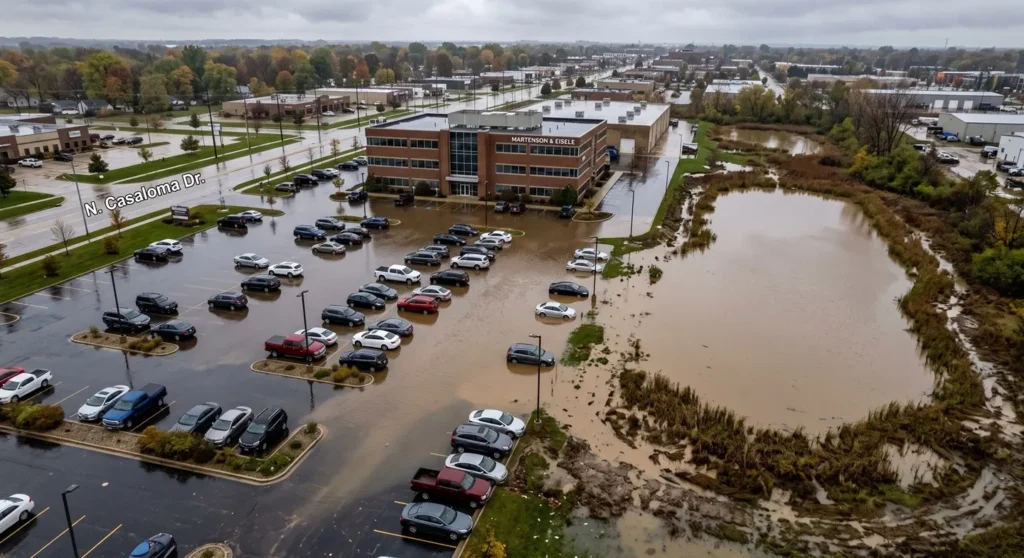
Except nobody factored in the heavy industrial delivery trucks parking directly above those plastic chambers during the spring thaw. The subgrade turns to mush. The underground chambers crack under the dynamic load. The parking lot collapses into a sinkhole big enough to swallow a delivery van. You lose two months of retail revenue while contractors tear up the entire asphalt section to replace the failed underground system with a conventional surface basin.
Surface drainage might look ugly on a rendering, but it works. You can mow it. You can inspect it. When November drops six tons of oak leaves onto your site, a landscape crew can actually clean out a surface swale. Burying complex pipe systems beneath high-traffic commercial zones just because you are greedy for three more parking spaces is reckless.
Where do you put the snow? The private plow guy always piles it directly on top of your flush catch basins. The snow melts during the day, freezes overnight, and suddenly your maximum-efficiency parking layout is a skating rink. People fall, they sue, and you lose.
Bioswales and Wisconsin Stormwater Management Maintenance
People love the idea of decorative green space. A bioswale planted with native prairie grasses filters out pollutants beautifully—provided someone actually remembers to weed the thing. If you let a swale get choked out by invasive weeds and parking lot trash, its hydraulic roughness changes entirely. The water slows down too much, backs up over the concrete curb, and turns your corporate entrance into a marshland.
Maintenance is the dirty word nobody wants to discuss at the project kickoff meeting. Who owns the basin ten years from now? Is it the city, or is it a dysfunctional homeowners association where nobody can agree on who pays to dredge out the muck? If you do not design for easy maintenance access, heavy excavator tracks will tear up people’s backyards just to clean out the silt.
Stop Fighting the Site
When you bring a site layout to Martenson & Eisele, we look at the regional drainage patterns and municipal ordinances with zero romanticism. If your plan requires an impossible combination of underground vaults and zoning variances to function, we scrap it. We design sites that conform to the natural topography. It saves you earthwork costs, keeps the DNR off your back, and ensures your pavement doesn’t wash out in three years.
Get the drainage right on the front end. Our surveyors, architects, and civil engineers know this state’s soil better than anyone. Bring us in before you finalize your purchase agreement.
Frequently Asked Questions
What are the NR 151 rules for Wisconsin stormwater management?
NR 151 is a state administrative code that mandates performance standards for runoff. For developers, it means you must control 80% of total suspended solids, meet specific infiltration volumes based on your development type (commercial vs. residential), and maintain protective vegetative buffers around wetlands and waterways.
Can I get an exemption from Wisconsin stormwater management infiltration rules?
Yes, but only under specific geotechnical conditions. If your site has soils with infiltration rates less than 0.6 inches per hour, or if you are dealing with shallow bedrock or high groundwater, the DNR and local municipalities may grant exemptions for the infiltration requirement. You still have to manage the discharge rate and water quality.
Why do municipalities care so much about Wisconsin stormwater management?
Because they are legally on the hook for water quality downstream. Under state and federal permits, cities and villages must prevent sediment and phosphorus from destroying local rivers and lakes. If your subdivision dumps muddy runoff into the municipal storm sewer, the city gets heavily fined. They pass that pain directly onto you by denying your permits.
How does winter weather impact Wisconsin stormwater management design?
Frozen ground doesn’t absorb water. When a heavy spring rain hits a snowpack sitting on top of frozen clay, you get 100% runoff. We have to design conveyance systems and emergency overflows that can handle massive, sudden volumes of ice-cold water without eroding the surrounding landscape or flooding adjacent properties.